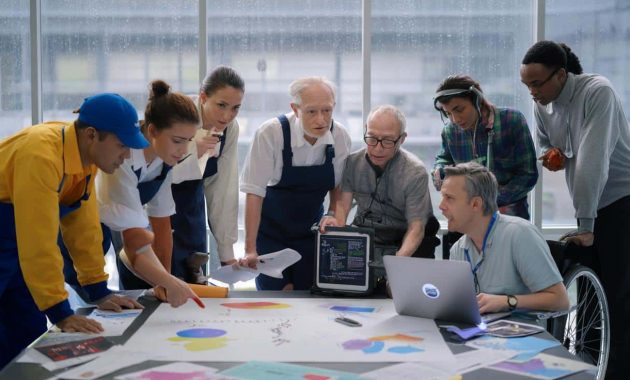
On a rainy Tuesday in London, a group of warehouse workers shuffled into a bright conference room, still wearing their high-vis jackets. A data scientist wheeled in a laptop, projecting lines of code and charts. The workers weren’t there for a performance review. They were there to give feedback to the algorithm that now decided their shifts, breaks, and bonuses.
At first, they sat stiffly. Then someone spoke up: “Your system says I’m ‘underperforming’ on Mondays. That’s the day I look after my mum in the morning.” The room went quiet. The data scientist started typing, rewriting logic on the fly.
That tiny moment captured something bigger: AI is no longer just about math.
It’s about who gets a voice in the room.
Why AI goes off the rails when people are left out
Walk into any tech office right now and you’ll hear the same buzzwords: models, pipelines, GPUs. You’ll hear a lot less about cleaners, call-center staff, junior clerks, or field technicians. Yet those are the people living with AI decisions every single day.
When AI is built in a vacuum, it quietly bakes in the blind spots of the team who coded it. No evil intent needed. Just limited life experience. A hiring model that’s never “met” a candidate who took a career break. A fraud system that flags people who move money between family members. A safety camera that misreads darker skin tones. AI starts mirroring the gaps in the room.
Take recruitment algorithms. One major tech company quietly dropped an internal hiring model after realizing it was downgrading résumés that mentioned “women’s” clubs or colleges. The system had been trained on ten years of male-dominated hiring data. No one on the original project team spotted the problem, because to them it looked normal.
Contrast that with a retail chain that built an AI shift scheduler with frontline workers at the table. They noticed patterns the data scientists missed: childcare windows, second jobs, late buses. People sketched their real days on paper, and the AI was adjusted to protect “no-go” hours. Turnover slipped down, and the union that had threatened to sue became one of the project’s loudest supporters.
What’s happening here is simple cause and effect. An AI system is a magnifying glass for the assumptions tucked into its data and design. When only a narrow group of people shapes those assumptions, the system overfits to their reality.
Bring in older workers, disabled staff, people in low-paid roles, and suddenly edge cases stop being “edges”. They become everyday use cases. The model improves not just ethically, but technically. Bias drops, error rates fall, customer complaints calm down. **Responsible AI isn’t a moral add-on. It’s a performance upgrade that starts with who’s invited into the process.**
Turning “inclusion” into something you can actually do on Monday
Start small and start where AI hurts the most: decisions that affect people’s pay, health, or dignity. List the systems that score, rank, or monitor workers. For each one, invite three to five people who are directly impacted to a short, paid “AI feedback session”. Call it a workshop, not a consultation.
➡️ This cleaning habit prevents mess from spreading unnoticed
➡️ Polar vortex forecast sparks alarm as experts quietly admit conditions could turn extreme fast
➡️ Gardeners who work with natural decline avoid sudden garden collapse
➡️ Are microwaves dangerous for your health?
➡️ Virginia Democrats fast-track new congressional map for 4 more seats
Give them plain-language screenshots, not abstract diagrams. Ask simple questions: “Where does this feel unfair?”, “What’s missing from this picture of your work?”, “When has this system got you wrong?” Then write their words down, literally. Use those phrases as test cases for the next version of the model. *This is boring, repetitive work – and that is exactly why it produces real change.*
A lot of companies trip up at this stage. They announce grand “AI ethics boards” with glossy photos, then bring in the same three executives to every meeting. Workers get one token survey, badly translated, with no result ever shared back. Trust evaporates.
There’s a kinder, more grounded way. Pay people for their time. Let them say “I don’t know” without losing face. Accept you’ll hear some anger, because AI often arrives on top of years of frustration with old tools. And remember the plain-truth line nobody likes to admit: **most people already assume that any new system will work against them, not for them.** Your first job is to prove them wrong, patiently, through your actions.
“AI isn’t neutral,” says an HR director at a manufacturing firm that recently overhauled its scheduling system. “It quietly chooses whose time matters. Once we saw that, we couldn’t unsee it. The only fix was to bring more people into the room and let them redraw the rules with us.”
- Include workers early: Invite frontline staff to the very first discussions about a new AI tool, not just the final testing phase.
- Pay for lived expertise: Compensate employees who join AI review groups, just as you would any specialist consultant.
- Use everyday language: Explain what the system does without jargon so people can challenge it meaningfully.
- Close the loop: Show how feedback changed the model or policy, even if the change is small.
- Rotate voices: Regularly refresh the group giving input so it reflects shifts, sites, ages, and backgrounds.
From fear of replacement to a shared sense of stewardship
There’s a quiet emotional shift that happens when people move from “AI is coming for my job” to “I help decide how AI works here”. It doesn’t erase all fears. But it replaces pure anxiety with a sense of stewardship.
We’ve all been there, that moment when a new tool lands in your inbox with no warning and no choice. You click around, feel dumb, blame yourself, then the system quietly starts shaping your workday. Shaping responsible AI through workforce inclusion is the opposite of that story. It’s messy, a bit slower, full of awkward questions. Yet that mess is where trust grows.
When a cleaner can veto an unsafe robot route, when a call-center agent can flag that the script generator is gaslighting customers, when an older employee can say “this interface is unreadable for my eyes” and be heard, AI stops feeling like a black box. It starts to look like shared infrastructure. And that’s when something surprising happens: the people once labeled “non-technical” become the very ones guarding the line between helpful automation and quiet harm.
| Key point | Detail | Value for the reader |
|---|---|---|
| Start from high-impact decisions | Map AI tools that affect pay, safety, or evaluation, and involve affected workers first | Focuses energy where inclusion prevents the biggest harms and conflicts |
| Turn feedback into test cases | Translate real worker stories into scenarios your AI must handle correctly | Improves fairness and accuracy with concrete, lived examples |
| Reward and renew participation | Pay contributors and rotate voices across roles, sites, and shifts | Builds long-term trust and keeps the AI aligned with changing realities |
FAQ:
- Question 1What does “workforce inclusion” in AI actually mean day to day?
- Question 2Isn’t AI too technical for frontline staff to contribute meaningfully?
- Question 3How can a small company with limited resources involve employees in AI decisions?
- Question 4What’s the risk of not including workers in AI design and deployment?
- Question 5Can inclusion really improve AI performance, not just ethics?
Originally posted 2026-03-12 23:27:27.