For more than a decade, a young woman buried on a Sussex cliffside carried a story that wasn’t really hers.
First hailed as Britain’s earliest known Black inhabitant, the so‑called Beachy Head Woman became a media symbol of Roman‑era diversity, before cutting‑edge genetics overturned almost every assumption made about her life and origins.
A forgotten box in a town hall basement
The story starts in 2012, in the muniments room of Eastbourne town hall. During a routine inventory, staff opened an unremarkable cardboard box. Inside lay a nearly complete skeleton, carefully packed, with a fading label suggesting it had been dug up near Beachy Head in the 1950s.
Nothing about the find looked headline‑worthy. The remains were passed to the local “Eastbourne Ancestors” project, which studied old burials from the region. Standard analyses followed. Anthropologists determined the skeleton belonged to a woman aged roughly 18 to 25, just over 1.5 metres tall, with evidence of a serious leg injury that had healed long before her death.
Radiocarbon dating placed her between 129 and 311 AD, right in the middle of Roman rule in Britain. Archaeologically, that fits. The Eastbourne area at the time was dotted with farms, villas and a coastal defence network linked to Pevensey fort and sites such as Bullock Down and Birling.
At first, the Beachy Head Woman was simply one more Roman‑period burial from rural southern Britain.
How a cautious guess turned into a national symbol
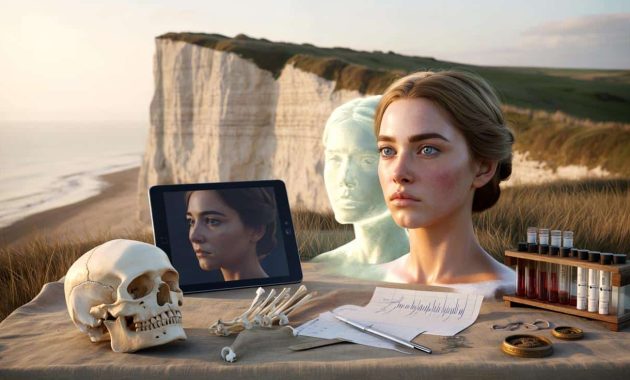
The quiet local case changed trajectory when the skull went to facial reconstruction expert Professor Caroline Wilkinson at Liverpool John Moores University. By modelling the skull’s shape, she produced a 3D reconstruction showing a young woman with features that could be consistent with sub‑Saharan African ancestry.
Wilkinson flagged that this was a tentative interpretation. Cranial morphology is messy, and similar traits can appear in very different populations. Yet that nuance mostly vanished as the story spread.
By 2016, the reconstructed face was doing the rounds in documentaries and museum displays. The local museum installed a plaque describing her as “the first known Black Briton”. The BBC included her in the series Black and British: A Forgotten History, presented by historian David Olusoga, as a powerful illustration of long‑standing African presence in Britain.
For many viewers and visitors, she became proof that Roman Britain looked far more mixed than schoolbooks once suggested. The image resonated strongly in debates about migration, racism and the country’s past.
➡️ What always walking with your head down really means, according to psychology
➡️ I tried this creamy baked dish and it surprised me in the best way
➡️ Your favourite colour says a lot about your personality, according to psychology
➡️ China planted so many trees in the Taklamakan Desert that it now absorbs CO2
➡️ The “Excalibur” sword found in Spain in 1994 may have Islamic origins
➡️ A study analyzed LED headlight power in cars, and the conclusion is what every driver already knows
The Beachy Head Woman was recruited into today’s culture wars long before scientists had firm evidence about who she actually was.
Early DNA attempts and the limits of skull‑based science
Behind the scenes, researchers were already uneasy. Physical anthropology has moved away from trying to “read” ancestry from skull shape. The method has a long, troubled history, and modern studies show huge overlap between populations. As Wilkinson herself pointed out, cranial traits alone cannot securely pinpoint someone’s geographical origins.
In 2017, a team led by ancient DNA specialist Dr Selina Brace at London’s Natural History Museum tried to extract genetic material from the bones. The sample was badly degraded. Only a few fragments of DNA could be read, hinting at a potential link with the eastern Mediterranean, possibly Cyprus. Even that weak signal never reached peer‑reviewed publication, since the data were too thin for strong claims.
With uncertainty mounting, the local museum quietly took down the “first Black Briton” plaque. Yet the bolder story had already taken root in the public imagination, shared widely online and in classrooms.
From cranial morphology to biomolecular approaches
The case became a textbook example used by archaeologists and geneticists to show why old skull‑based typologies fall short. Modern bioarchaeology now leans heavily on:
- Ancient DNA sequencing
- Isotope analysis of teeth and bones to reconstruct diet and mobility
- Contextual archaeology (grave goods, local settlement patterns)
On paper, everyone agreed: better methods were needed. The question was whether the Beachy Head Woman’s DNA was still recoverable at all.
Next‑generation genetics overturn the story
The technological break came in 2024. Brace and colleagues at the Natural History Museum, the University of Reading and University College London applied “capture array” technology, a technique that fishes out tiny, damaged DNA fragments from ancient samples.
This time, the team generated a genome around ten times more complete than before. With that, they could compare her genetic profile to large reference databases of ancient and modern individuals from across Europe, the Mediterranean and Africa.
The new study shows the Beachy Head Woman was genetically indistinguishable from other rural communities in Roman‑era southern Britain.
The December 2025 paper in the Journal of Archaeological Science is blunt: her ancestry matches local Romano‑British populations. No meaningful signal points to recent African or Mediterranean roots.
The team also examined genes linked to pigmentation. Those suggest she likely had light skin, blue eyes and fair hair — almost the exact opposite of the public image that had built up around her.
A new facial reconstruction, based on the same skull but updated pigmentation data, shows a young woman who would have blended into local Romano‑British villages rather than standing out as foreign.
A scientific correction with social ripples
This reversal has produced mixed reactions. For many scientists, the relief is obvious: the data finally match the story being told. As Brace has put it, the point is not rewriting national history, but giving this individual the most accurate biography possible.
For some members of the public, the shift feels like something important being taken away. The Beachy Head Woman had become a reassuring figure, an early face of Black British history in a landscape where such figures are still under‑represented in museums and textbooks.
Archaeologist Professor Hella Eckardt of the University of Reading, a co‑author of the study, argues that this tension needs to be faced, not avoided. The Roman Empire did bring people from across Africa, the Middle East and continental Europe into Britain. Other graves in Dorset and Kent, for instance, show mixed European and sub‑Saharan ancestry in the early medieval period. Those cases remain valid.
The Beachy Head Woman’s new story does not erase diversity in Roman Britain; it just removes one data point that never really belonged.
The role of museums and media
The case also raises uncomfortable questions for institutions. When the first reconstruction appeared, both the museum and the media leaned into the most striking possible narrative, while the underlying caveats were quietly sidelined.
For curators and broadcasters, the episode underscores a few lessons:
| Issue | Lesson |
|---|---|
| Preliminary findings | Present as hypotheses, not facts, especially on ancestry or identity. |
| Media amplification | Striking visuals spread faster than methodological caveats. |
| New data | Be ready to update labels, reconstructions and school resources. |
| Social impact | Engage with communities about why interpretations change. |
These points affect more than one skeleton in Sussex. As ancient DNA projects expand, similar corrections are likely for other “celebrity” burials across Europe.
What the case reveals about how science actually works
The Beachy Head Woman’s journey, from anonymous box to public icon to revised biography, tracks the awkward, iterative path of science itself. Initial ideas are often rough and based on partial data. They get tidied up when retold to the public. Only later do stronger methods come along, forcing a rethink.
In this sense, the story is less about race and more about method. Cranial morphology once stood at the centre of physical anthropology. Today, in ancestry research, it sits closer to the sidelines, overshadowed by genetics and chemical analyses of bones and teeth.
For anyone following archaeological news, the case offers a practical reminder: a visually compelling reconstruction is not the same thing as a secure scientific conclusion. When a striking new claim about ancient identity appears, two questions help:
- Has the data been published in a peer‑reviewed journal?
- Is the claim backed by genetics, isotopes or multiple lines of evidence, or just by appearance?
Key terms and why they matter
Several technical terms in this debate are worth clarifying for non‑specialists.
Ancient DNA (aDNA): Genetic material recovered from bones or teeth that are often thousands of years old. It breaks down over time, so scientists work in ultra‑clean labs and rely on sensitive sequencing technologies. Even then, not every skeleton yields usable data.
Capture arrays: A lab method that uses short bits of synthetic DNA as “hooks” to latch onto matching fragments in a degraded ancient sample. This allows researchers to enrich the tiny pieces they care about and ignore most contamination and damage, which is key for cases like Beachy Head.
Multiproxy approach: The 2025 study did not rely on DNA alone. It combined skeletal analysis, radiocarbon dating, archaeological context and biomolecular evidence. The idea is simple: the more independent lines of data that tell the same story, the stronger the interpretation.
Imagining her life in Roman Sussex
The new genetic picture does not drain the Beachy Head Woman’s story of interest; it redirects it. Instead of a migrant from far away, we are now looking at a local woman living under Roman rule, tied into imperial networks through trade, law and military presence rather than long‑distance travel.
Her healed leg injury hints at a life that included trauma but also care. Someone tended to that wound; someone made sure she survived. She probably spoke a mixture of the local Celtic tongue and at least some Latin words, heard coins clinking stamped with emperors’ faces, and moved through a landscape dotted with tiled roofs and Roman roads.
For teachers, museum guides and history buffs, her case can be used in two ways at once: as a reminder that Roman Britain was not ethnically uniform, and as an example of how personal stories can drift far away from the evidence when we rush to fill gaps with modern desires.
There is also a broader risk here. When past individuals are turned into symbols for present‑day causes, they can be flattened into one trait — skin colour, migration, gender — and everything else about their lives quietly disappears. The latest research nudges us back toward seeing the Beachy Head Woman as a whole person: local, Romano‑British, injured, young, and now, finally, a little more accurately known.
Originally posted 2026-03-11 18:02:50.